
Government claim
A government claim allows the government to collect an overdue debt from a debtor’s payments account, such as a tax debt.
A bank is obliged to execute a government claim on a customer. When the debt is debited, ‘Government claim’ will appear in the description on the transaction statement, together with a file number and a telephone number that the debtor can call for more information.
When does the government use a government claim?
- Someone owes the government a debt of up to €1,500.
- He or she does not pay that debt, even after reminders and a writ of execution.
- The debtor has a payments account.
How does the government claim work?
The government claim is a debit from a payments account on the instructions of a government agency without the account holder’s consent. The account holder cannot reverse this debit. Nor can the account holder block their payments account in advance for government claims. A bank is obliged to execute a government claim. A government institution and the debtor’s bank are not required to notify the debtor of a government claim.
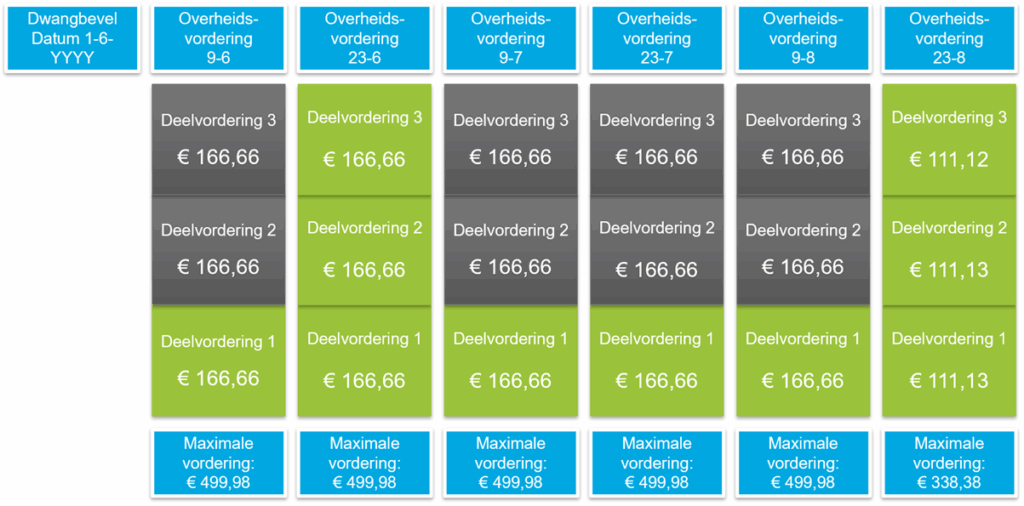
The government collects a large debt (up to €1,500) in several installments. For a period of three months, the government agency may submit three partial claims twice a month. The government agency may claim a maximum of €166.66 per partial claim. This amounts to a total of €499.98 per claim and €999.96 per month.
If the account holder is allowed to be overdrawn, a government claim can also lead to an overdraft of up to €1,500 (but never more than the account holder’s maximum overdraft limit set by their bank).
For example: a government agency claims €150; the balance in the debtor’s payments account is €50.
- The account holder is not allowed to be overdrawn: the claim is unsuccessful; the account balance remains €50 and the debt to the government institution remains unchanged.
- The account holder is allowed to be €50 overdrawn: the claim is unsuccessful; the account balance remains €50 and the debt to the government institution remains unchanged.
- The account holder may have an overdraft of €100: the claim is successful; the account balance becomes €100 negative (in the red) and the debt to the government agency is reduced by €150.
The image below shows an extreme example. In this example, the government agency needed 6×3 partial claims to collect €1,500 in 3 months. On three days, 2 of the 3 partial claims failed because the account balance was too low.
The debtor can address all questions, complaints, and objections about a government claim to the government agency that ordered the claim. To this end, the file number and telephone number of the government agency are included in the description on the transaction statement for each (partial) claim.
When is a government claim not applicable?
- There is insufficient balance in the debtor’s payments account.
- The claim is too high for the debtor’s seizure-free threshold.
- The government debt is higher than €1,500.
- The debtor’s payments account has been blocked by the bank.
- There is a pledge on the balance of the debtor’s payments account.
- The debtor is in debt restructuring.
- The debtor is in personal bankruptcy.
- The Government Claim does not apply to savings accounts.
- The Government Claim does not apply to a positive credit card balance.
- The debtor’s bank is not covered by the Government Claim.
Conditions for government institutions
- A government institution must be authorized to execute the Government Claim.
- The government institution’s bank must be able to execute Government Claims.
- The government institution has a contract with its bank for the Government Claim.
- The government institution has a separate account exclusively for the Government Claim.
Which government institutions?
These government institutions, among others, use the Government Claim:
- Tax and Customs Administration
- Provinces
- Municipalities: Partnerships of municipalities
- Water boards: Union of Water Boards
- Central Judicial Collection Agency (CJIB)
For government institutions and their banks
The specifications for the Government Claim:
- For government institutions: Specifications for users of the Government Claim.
- For credit banks: they can request the specifications from the Dutch Payments Association.
Highlights of agreements concerning Government Claims:
- The timelines for submitting and processing a Government Claim are the same as the timelines for Standard European Direct Debit.
- The government institution does not have to submit a Government Claim on the day of execution. Ask the bank what the deadline for submission is.
- The file format for submitting Government Claims is the same as the file format for Standard European Direct Debit.
- The credit bank has instructions for the description that the government agency must provide with each Government Claim.
- The government agency enters the code ‘NLGOV’ in the ‘local instrument’.
- The government agency enters the code ‘NURG’ in the ‘service level field’.
- The feedback from the credit bank about processed government claims is the same as the feedback for Standard European Direct Debit.
Banks
View the list of banks that can act as credit banks for government claims. Government agencies can instruct these banks to execute a government claim. Is there a credit bank that no longer belongs on this list, or one that should be added? Send a message to the Dutch Payments Association.
Government claims may only be executed on a payments account. Government claims that do not meet this requirement must be reversed by the bank within five working days of presentation. Reversals are carried out via the Standard European Direct Debit process.
The bank may not charge separate costs for executing a government claim.
Role of the Dutch Payments Association
The Dutch Payments Association manages the agreements for the submission of government claims. Government institutions and banks can contact the Dutch Payments Association if they have any questions.