
Consumers are buying more products and fewer services online
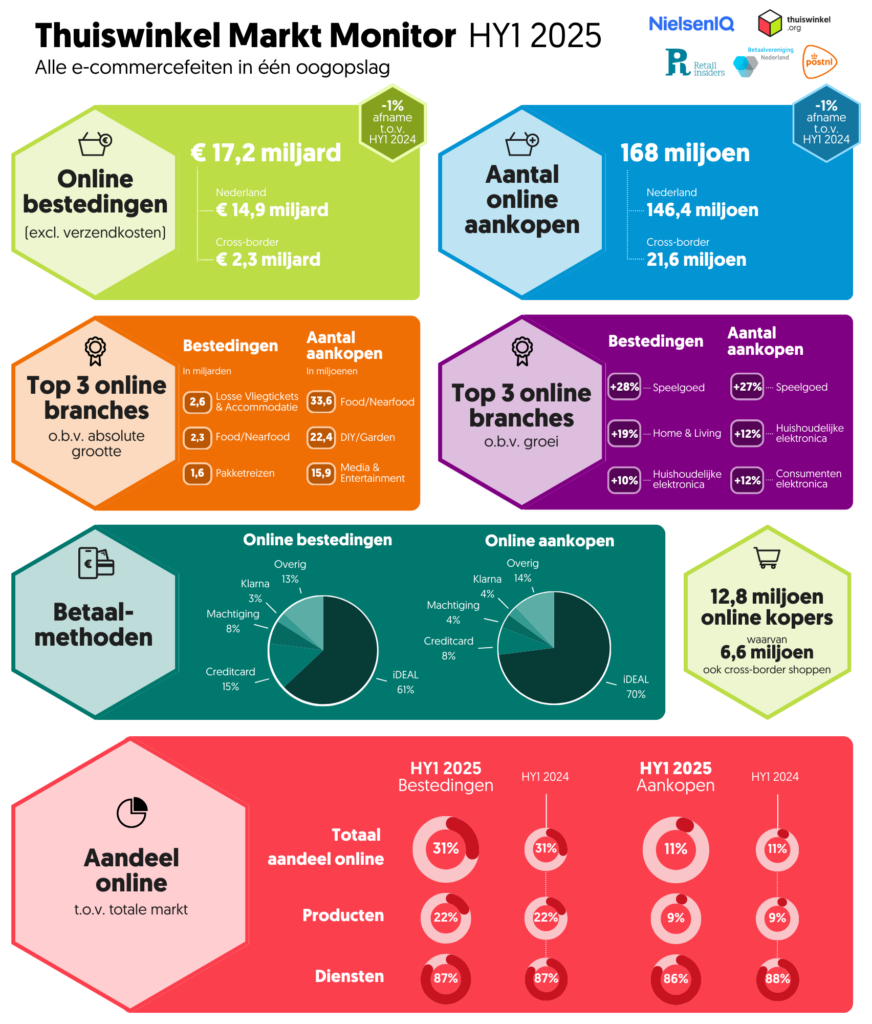
Dutch consumers spent over €17 billion online in the first half of 2025, 1% less than in the same period last year. This decrease is due to declining spending on services (-7%). The total number of online purchases came to 168 million (-1%), of which 144 million were product purchases. The number of purchases of services fell by -12%. This is according to the latest figures from the Thuiswinkel Markt Monitor, the research into online consumer purchases in the Netherlands. The research is conducted by NielsenIQ (NIQ), commissioned by Thuiswinkel.org and Retail Insiders and in cooperation with PostNL and Betaalvereniging Nederland.

First decline Tickets for Attractions and Events since Corona
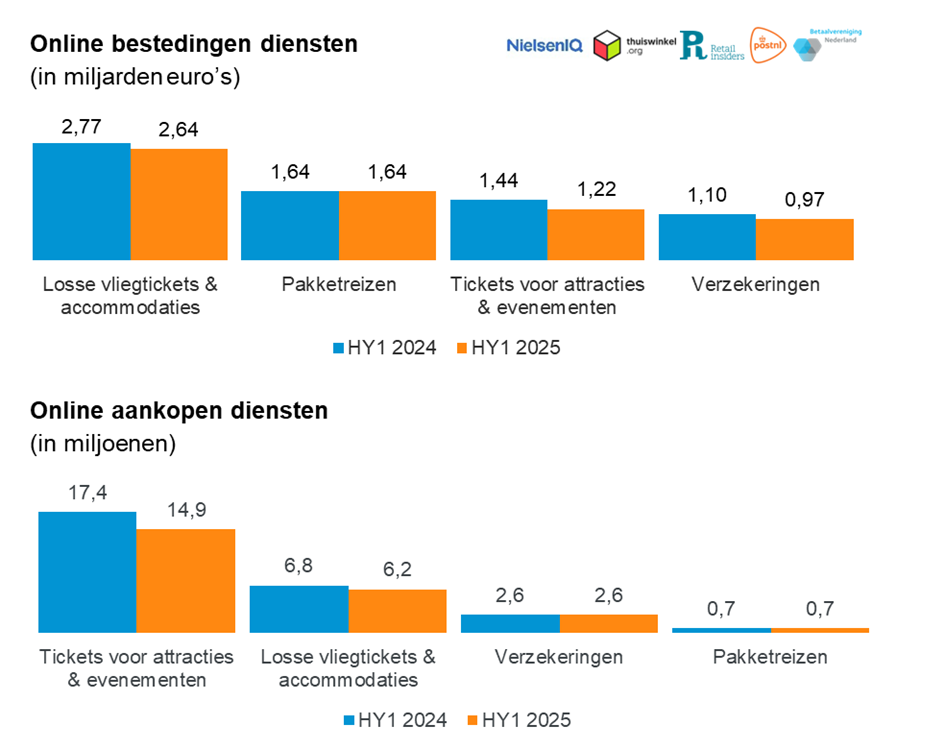
Online spending on services shows a clear decline, mainly due to a strong decrease in Tickets for Attractions and Events (-16%). The number of online purchases in this category also decreases sharply (-15%). This downward trend started in the first quarter of 2025 and marks the first decline since COVID-19.
Other service categories are also experiencing a decline (see Figure 1). As a result, the share of services in the entire online market is decreasing again. Paul Nijhof, interim director of Thuiswinkel.org says: “After the corona pandemic, we saw huge growth in all service categories. That growth now seems to have worn off: consumers are spending less on experience and leisure. For example, we see a decline in spending on festivals, concerts and sporting events.”
Home & Living grows after years of contraction
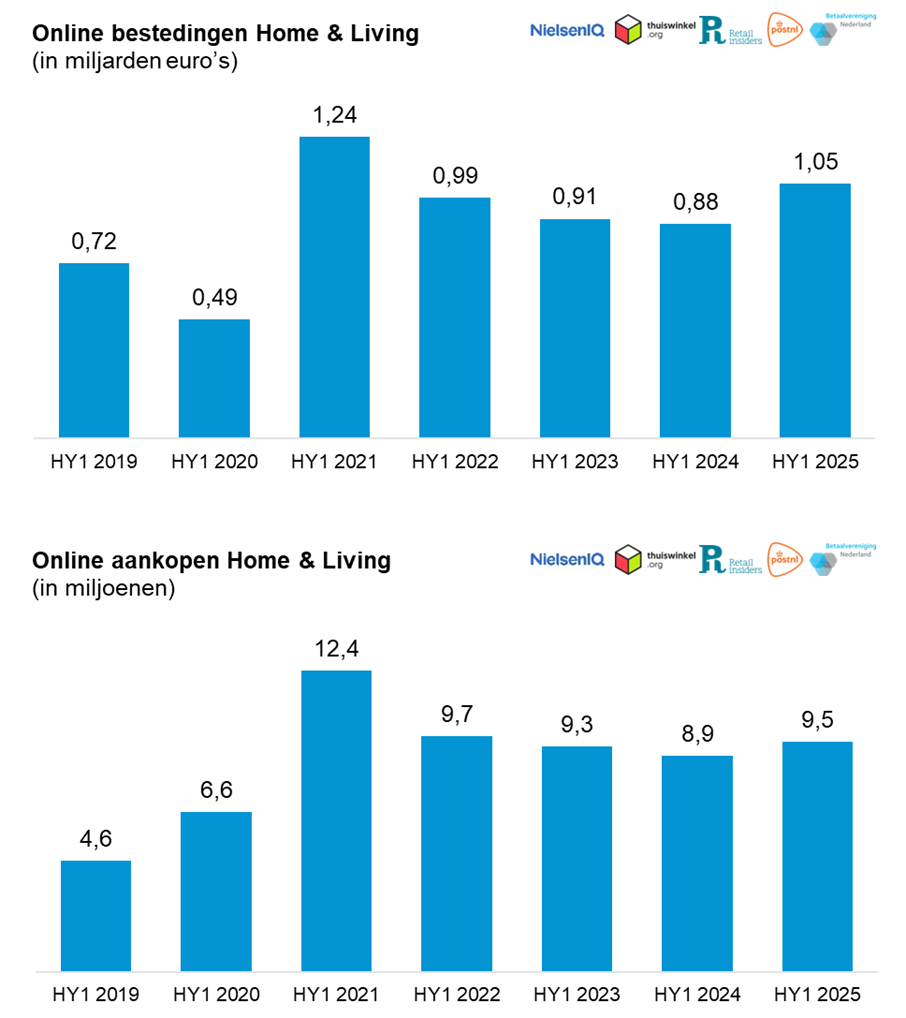
Online spending on products increases by 3%, the number of online purchases grows by 1%. Home & Living in particular stands out. This category shows growth of 19% again after years of declining online spending. The number of online purchases of Home & Living increases by 7% (see Figure 2). The largest online category, Food/Nearfood, grows by 9% in spending and 7% in number of purchases. Nijhof: “Consumers are spending less on experiences, and more again on products for the home. During Corona, Home & Living experienced a sharp peak, but thereafter growth failed to materialise. Because many products in this category are not replaced quickly, replacement purchases may be taking place now – five years later. We also see that furniture is increasingly being bought online instead of in physical shops.”
Further rise in online purchases in China, decline in US and UK
Online cross-border spending drops slightly by 1% to €2.3 billion, while the number of purchases grows by 8% to 21.6 million. Also cross-border, spending on services falls (-12%) and spending on products grows ( 13%). The number of purchases falls by 8% for services, and grows by 11% for products.
Dutch consumers are increasingly buying cross-border from Chinese online shops. Of all online purchases abroad, 30% are now made at Chinese webshops: 6.5 million purchases in the first half of 2025. This compares to 5.9 million purchases in the first half of 2024. Spending at Chinese online shops is actually decreasing, from € 248 million to € 196 million.
The United States and the United Kingdom are losing share in both the number of purchases and spending. For instance, Dutch consumers buy less Loose Flight Tickets & Accommodations (-33%) and IT products (-47%) at US webshops, and less Telecom (-69%) and Tickets for Attractions and Events (-39%) in the UK.
Smartphone use continues to grow, iDEAL use declines
Dutch consumers are increasingly making their online purchases via smartphones. Since the first half of 2021, 3 to 5 percentage points have been added annually. In the first six months of 2025, 40% of online purchases will be made via a smartphone. The increasing use of smartphones is at the expense of the desktop/laptop share, which now stands at 46%. “Online shopping via a smartphone has been increasing in popularity in recent years. Young people in particular often use their phones for online purchases. However, the average amount spent via smartphone (€79) remains lower than via laptop (€122). Consumers use their smartphone especially when the average purchase amount is relatively low, such as Food/Near Food, Clothing and Shoes & Personal Lifestyle,” says Nijhof.
The share of iDEAL within online purchases is decreasing. Whereas in the first half of 2024, 73% of purchases were still paid with iDEAL, it will be 70% in the first half of 2025. This decline is due to a shift in the use of iDEAL to other payment methods. On the contrary, the share of Klarna increases, from 3% to 4%, mainly due to increasing use in Clothing and Shoes & Personal lifestyle.
Want to read more about developments in e-commerce or delve deeper into the data? Members of Betaalvereniging Nederland get the report and access to the dashboard via their InfoNet account. To do so, go to Login – InfoNet (betaalvereniging.nl). The report can be downloaded via the ‘Explanation dashboard’ page. Please note that access to this dashboard requires logging in with an Infonet account and corresponding password.
Gerelateerde artikelen
-

Scams tap into migration of iDEAL to Wero
-
News
-
Security
-
-

Consumers increasingly buy online via smartphone
-
News
-
Online payments
-
-

Stablecoins: ‘protecting and participating’
-
News
-
Crypto
-
-

Reply to stablecoins is wholesale CBDC, not retail digital euro
-
News
-
Crypto
-
-

New agreements should improve access to business checking account
-
News
-
Special accounts and services
-
-

Payments newsletter: Betaaljournaal 34
-
Payments newsletter
-